Contents
AP Physics C Mechanics: Lecture Notes
These are the notes of my AP Physics C: Mechanics lectures. AP Physics C uses calculus from the first day: velocity is the derivative of position, and displacement is the integral of velocity. So the course starts with kinematics and the little calculus it needs, and each new tool is introduced when the physics asks for it. The examples are the ones we worked through on the board.
| Unit | Topic | Status |
|---|---|---|
| 1 | Kinematics, vectors and projectile motion | in progress |
| 2 | Force and translational dynamics | coming later |
| 3 | Work, energy and power | coming later |
| 4 | Linear momentum | coming later |
| 5 | Torque and rotational dynamics | coming later |
| 6 | Energy and momentum of rotating systems | coming later |
| 7 | Oscillations | coming later |
1. Kinematics in One Dimension
We study motion along a straight line. We choose an origin and a positive direction on the line; positions to the right of the origin are positive, positions to the left are negative.
Position, Velocity and Acceleration
Definition. For a body moving on a line,
- , the position, is a function of time ;
- , the velocity, is a function of ;
- , the acceleration, is a function of .
In the first part of the course the acceleration is constant: for one fixed number , such as , , , or .
Definition. The velocity is the derivative of the position:
Even on a line, velocity is a vector. In one dimension its direction is only a sign: means the body moves in the positive direction, means it moves in the negative direction.
Average and Instantaneous Velocity
Definition. The average velocity between the times and is the slope of the secant line through the points and of the position graph.
Example. Let . What is the average velocity between and ?
Now keep and move closer to :
With ,
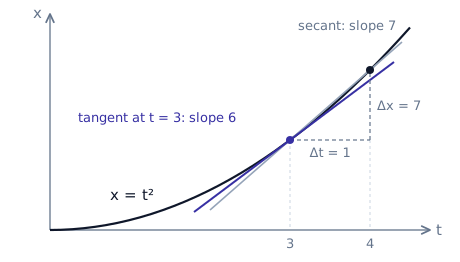
This is the link between average and instantaneous velocity: the derivative.
Definition. The instantaneous velocity is the limit of the average velocity as : It is the slope of the tangent line to the position graph.
The Power Rule
Theorem (Power rule). If , then
Example. For the motion above, , so and . At , the same value as the limit of the table.
Acceleration
Definition. The average acceleration is , and the instantaneous acceleration is the derivative of the velocity:
For we get and .
Derivative and Integral: Reading the Graphs
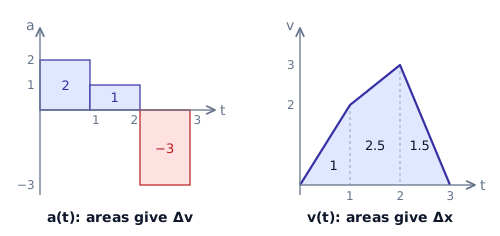
Going down from to to we take derivatives. Going up we take integrals:
- the area under the – graph between and is the change in position, ;
- the area under the – graph between and is the change in velocity, .
Area below the -axis counts as negative.
General Formulas
Summary.
- Speed is the absolute value of the velocity: .
- Average velocity: .
- Average speed: .
- Average acceleration: .
Remark. Displacement and distance are different. A body that goes from to has displacement , but the distance it travelled is .
Derivative Examples
| Function | Derivative |
|---|---|
| a constant: | |
Remark. A derivative of a sum is the sum of the derivatives, but a derivative of a product is not the product of the derivatives: . For products we use the product rule, "derivative of the first times the second plus the first times the derivative of the second":
Example. A body moves with . Find its position, velocity, speed and acceleration at .
So , , , and the speed is .
Equations of Motion with Constant Acceleration
Assume that the moving body is at at and has the velocity at .
Example. Let , and . A function whose derivative is is , where can be any number: In the same way
Summary (Constant acceleration). In general, with , and : Two more formulas follow from these: In terms of changes: , and .
Example. A body starts from rest at the origin with acceleration . Find its velocity and position after s.
, , , so and . Then and .
Example. A body has , and . What is its average velocity between and ?
Graphs of , and
Example. For we have and . The position graph is a parabola, the velocity graph is a line through the origin, and the acceleration graph is a horizontal line. Between and , the area under the -graph is the triangle , and the area under the -graph is the rectangle .
Example. The acceleration of a body is on , on and on . If and , find and .
The areas under the -graph are , and , so the velocity grows to , then to , and falls back to The velocity graph is made of straight pieces, and is the total area under it:
Practice Problems
Exercise (1). A body moving in the positive direction passes the origin at . From to s it moves with the constant speed m/s. At s it is given a constant acceleration of in the negative direction. Where is it at s?
Solution. For and the formula gives , so from to s the body travels m. From s to s it starts at m with m/s and for s:
Exercise (2). A position–time graph of a body moving under a constant force shows m at s and m at s. The body does not turn back in between. What is its average speed between s and s?
Solution.
Exercise (3). A body is uniformly accelerated from rest. What do the graphs of distance against time and speed against time look like?
Solution. With we have and . The distance graph is a parabola that opens upward (it gets steeper and steeper), and the speed graph is a straight line through the origin.
Exercise (4). The velocity of a body moving on a line rises steadily from , stays constant for a while, then falls steadily back to . Describe its position graph.
Solution. The slope of the position graph is the velocity. While the velocity grows, the position graph gets steeper (it bends upward); while the velocity is constant, it is a straight line; while the velocity decreases to , it gets flatter (it bends downward) and ends horizontal. The position keeps increasing the whole time, because the velocity is never negative.
2. A Little Calculus: Derivatives and Integrals
Taking the derivative goes from the function to its derivative; integration goes backwards, from the derivative to the function.
Derivatives of Basic Functions
| Function | Derivative |
|---|---|
| a constant : | |
| (power rule) | |
| (its own derivative) | |
Examples of the Power Rule
- : .
- : .
- : , .
Remark. Read the power rule backwards. To get the derivative we need ; to get we need ; to get we need ; to get we need .
| Function | Derivative | Power of the derivative |
|---|---|---|
| (none) | ||
No power has the derivative : the power is missing from the last column. The function whose derivative is is .
Basic Rules of Differentiation
- Constant multiple: . For example .
- Sum: : the derivative of a sum is the sum of the derivatives. For example .
- Product: . For example .
- Quotient: . For example .
- Chain rule: .
Example. is with and , so For : .
Basic Integration Rules
An integral asks: which function has this derivative? In all of these, is a constant number.
Example.
The Definite Integral
Definition. The definite integral is the area between the graph of and the -axis from to . In calculus it is defined as a limit of sums, ; the integral sign is a stretched S, for "sum", like the Greek capital sigma .
To compute it, find a function with and take , written .
Example. The area under from to is a trapezoid: . With the integral, The area under from to is not a simple shape, but the integral still works:
The Derivative at a Point
The derivative of a function at a point is the number .
Example. . What is the derivative at ?
Example. The position of a particle at time is . Find its velocity at and , and its acceleration at .
Constant Acceleration, Seen Through Integration
For a constant acceleration , integrating once gives and integrating again gives . The degree goes up by one each time:
- the – graph is a horizontal line (degree );
- the – graph is a straight line (degree ), steeper for larger ;
- the – graph is a parabola (degree ). When the "parabola" is a straight line.
Example. A particle starts from rest at the position with acceleration .
(i) Find its velocity at . (ii) Find its displacement between and .
(i) . From rest: , so and
(ii) . From we get , so and
3. Free Fall: Vertical Motion
Vertical motion is the same as motion on a line, with two changes: we write instead of , with the positive direction up, and the acceleration is constant,
Summary (Free fall).
Remark. The acceleration of gravity always points down, towards the Earth. In the formulas the sign of is the sign of the direction we chose as positive: with "up is positive", .
Example. A particle is thrown upward with the initial velocity m/s. Where is it at s? After one second it has already passed its starting point on the way down: it is m below it.
4. Vectors
In two dimensions velocity and acceleration are vectors with a direction in the plane, not only a sign. Before we move on to motion in the plane, we collect what we need about vectors.
Vectors and Scalars
Definition. A scalar is a quantity given by a single number, without direction: distance, speed, mass, time. A vector is a quantity with a direction and a magnitude (size): displacement, velocity, acceleration, force.
A vector is drawn as an arrow: its length is the magnitude and the way it points is the direction. Moving an arrow without turning it or changing its length does not change the vector. For example " units at the angle " is the same vector wherever we draw it.
Definition. For the vector from the origin to the point , the magnitude (length) is and its direction is the angle with the positive -axis, where The angle is measured counterclockwise (c.c.w.) from the positive -axis; a clockwise angle is negative.
The slope of the arrow is . In three dimensions there is a -axis too, and a vector is given by three numbers.
Remark. We name angles with Greek letters: (theta), (alpha), (beta), (gamma).
A Little Trigonometry
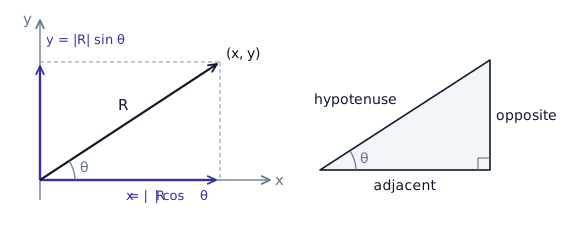
Summary. In a right triangle with the angle ,
| Degrees | |||
|---|---|---|---|
| undefined |
These values come from two triangles: the –– triangle with sides , , , and the –– triangle with sides , , . A third triangle that appears often in physics problems is the –– triangle, whose angles are about and .
Definition. Angles are measured in degrees or in radians. A full turn is rad, so
Remark. Check which mode your calculator is in. If it works in radians, means the cosine of radians; for type .
Components of a Vector
Definition. The components of a vector with magnitude and direction are They tell how far the vector goes along each axis.
Example. A rope pulls a boat with the force N at below the horizontal. The force pulls forward with N and downward with N.
On a slope of , a vector of length along the slope has the horizontal component and the vertical component .
The other way round, from the components we get the magnitude and the direction:
Example. goes from the origin to . Then
Example. goes from the origin to . Then and : the –– triangle.
Example. goes from the origin to . A calculator gives , but the vector points into the second quadrant (left and up). It makes with the negative -axis, so measured counterclockwise from the positive -axis its direction is
Remark. only gives angles between and . When (second or third quadrant), add to the calculator's answer. Always draw the vector first.
Adding Vectors
Definition. Tip to tail: to add , draw starting at the tip of . The sum, the resultant, goes from the tail of to the tip of .
Parallelogram: draw and from the same point. The sum is the diagonal of the parallelogram they span.
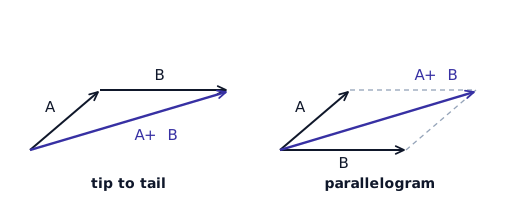
The parallelogram shows that . More vectors are added the same way, one after the other: for put each arrow at the tip of the one before, and the resultant goes from the tail of the first to the tip of the last.
Multiplying by a Number, Subtracting
A vector can be multiplied by a number (a scalar). points the same way as and is twice as long; is half as long; has the same length and points the opposite way; is the zero vector.
Definition. Subtraction is adding the opposite vector: .
In a drawing, if and start at the same point, goes from the tip of to the tip of . In the same way is drawn tip to tail with and reversed.
The Algebraic Method
In components, vectors are added and subtracted coordinate by coordinate. A vector that goes units in the direction and units in the direction is .
Summary. If and , then The vector from the point to the point is .
Example. and give .
From to : , one unit right and four units up.
The Law of Sines and the Law of Cosines
When we add two vectors with a drawing, we get a triangle that need not have a right angle. Two rules connect its sides and angles. In a triangle , the side is opposite the angle , is opposite , and is opposite .
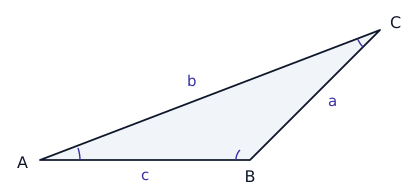
Theorem (Law of sines).
Example. A triangle has the angles , and , and the side opposite the angle is m. Call the side opposite and the side opposite . Then
Theorem (Law of cosines). For a right angle, and this is the Pythagorean theorem.
Example. Two sides of a triangle are and , and the angle between them is . The third side satisfies
Adding Vectors with Components
The easiest way to add several vectors: split each into components, add the -components and the -components separately, and turn the result back into a magnitude and a direction.
Example. at , at , at . Find .
| -component | -component | |
|---|---|---|
So , with
Example. Two forces act on a point: of N at and of N at . Find . For the direction, ; but and , so is in the second quadrant and its angle is .
Summary and Strategy
Summary.
- Vectors have a magnitude and a direction; scalars have only a magnitude. Force, displacement and velocity are vectors; distance, speed and mass are scalars.
- A vector can be split into components along the axes.
- Vectors are added tip to tail; the sum is called the resultant.
- Two vectors in the same direction give a resultant whose magnitude is the sum of their magnitudes; two vectors in opposite directions give the difference of their magnitudes. Every other angle gives something in between.
When solving a vector problem:
- Understand the frame of reference of the situation.
- Choose a coordinate system that suits it. The axes need not be horizontal and vertical: for a block sliding down a slope, take the -axis along the slope.
- For a drawing, pick a scale, for example cm for m.
- Keep the directions given in the problem (north, east, south, west) the same in your drawing.
- Connect the vectors tip to tail; the resultant goes from the tail of the first to the tip of the last.
- Find the components. Most vector problems become simple in components.
Practice Problems
Exercise (1). A vector has the components and . What angle does it make with the positive -axis?
Solution.
Exercise (2). Which pair of vectors can have a resultant of magnitude : and ; and ; and ; and ?
Solution. The resultant of two vectors lies between the difference and the sum of their magnitudes (opposite directions give the difference, the same direction the sum). The ranges are –, –, – and –. Only and can give .
Exercise (3). A vector of magnitude units makes with the positive -axis. What is its horizontal component?
Solution. units.
Exercise (4). As the angle between a vector and the horizontal grows from to , what happens to its vertical component?
Solution. The vertical component is , and grows from to on this range, so the vertical component increases.
Exercise (5). Which of these sets of displacements have the same resultant? I. m east, m north, m west. II. m north, m west, m east. III. m east, m west, m north. IV. m north, m east, m west.
Solution. Take east as and north as and add components. I: . II: . III: . IV: . So I, III and IV have the same resultant; the order of the steps does not matter.
Vector Notation
Definition. and are the vectors of length in the positive and directions. Every vector in the plane can be written with them: In three dimensions a third unit vector is added for the -axis.
For example goes units to the right and units up. Vectors are added and multiplied by numbers component by component.
Example. Let and . Then
5. Kinematics in Two Dimensions
Position, Velocity and Acceleration in Two Dimensions
Definition. The position of a particle moving in the plane is given by two component functions: The curve that the tip of draws is the trajectory of the particle.
How do we find the velocity vector at any time ? We differentiate each component.
Summary. The velocity vector is tangent to the trajectory.
Example. . Then . At s,
The Complete Definitions
Summary.
- Instantaneous velocity: . Here is the change of position, the displacement.
- Instantaneous speed: , the magnitude of the velocity vector.
- Instantaneous acceleration: . Here is the change of velocity.
Remark. In two dimensions , and are all vectors.
The Displacement Vector
Definition. If the particle is at at time and at at time , its displacement vector is It depends only on the two end points, not on the path between them.
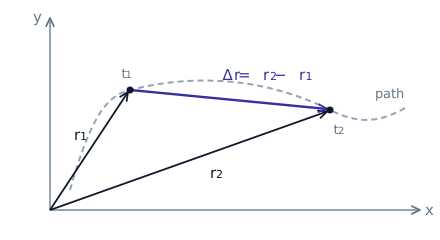
Example. If and , then
Example. . What is the displacement vector between and ? The velocity and the speed are and the acceleration is . Integrating the speed gives the distance travelled along the path; in the first three seconds it is (by calculator), more than the length of any straight segment between the end points.
Constant Acceleration in Two Dimensions
The formulas pass from one dimension to two by putting vectors in place of numbers:
Summary. We work with the component functions separately:
Example. A particle is at at and has the velocity .
(i) Find . (ii) Find the position function .
(i) .
(ii) Integrate each component ( becomes ): From we get , so
The Dot Product
Definition. The dot product (scalar product) of and is the number
Theorem. , where and are the lengths of the vectors and is the angle between them. So
Example: Two Paths That Meet
Example. Sally is chasing Calvin. Calvin moves along the path and Sally along .
(a) Will Sally catch Calvin? (b) If so, what is the angle between their velocities when they meet?
(a) They meet at a time when , that is, when both coordinates are equal at the same moment. The -coordinates are equal when This is the only time at which they have the same -coordinate. At that moment the -coordinates are and , also equal. So yes: at they meet at the point .
(b) The velocities are so at : and . Then
The same angle can be read from a drawing: makes with the positive -axis, and points below it, so the angle between them is .
Example: From Velocity to Acceleration and Displacement
Example. A particle moves in the plane with the velocity (in m/s).
(a) What is its acceleration as a function of time? (b) What is its displacement between and ?
(a) .
(b) We need a function whose derivative is : The derivative of is for every constant ; in the same way the derivative of is for every . The constants cancel in the displacement: ( is in radians.)
6. Projectile Motion
Polar and Rectangular Coordinates
Every point of the plane can be given in two ways: by its rectangular coordinates , or by its polar coordinates , the distance to the origin and the angle of rotation from the positive -axis.
Summary.
For a velocity the same formulas give the speed and the direction of motion:
Example. A particle is thrown with the speed m/s at an angle of above the horizontal. Its velocity components are
The Equations of Projectile Motion
Note (Standard assumptions). Unless told otherwise, there is no air resistance, and the only force on the object is gravity, which gives it the downward acceleration (we often use , or for easy numbers).
We analyse projectile motion as two one-dimensional motions, one on the -axis and one on the -axis, superposed. A projectile launched with speed at the angle has and .
Summary (Projectile motion). On the -axis there is no acceleration: On the -axis the acceleration is :
Here is the horizontal component of the velocity vector at time ; it never changes.
Problem-Solving Tips
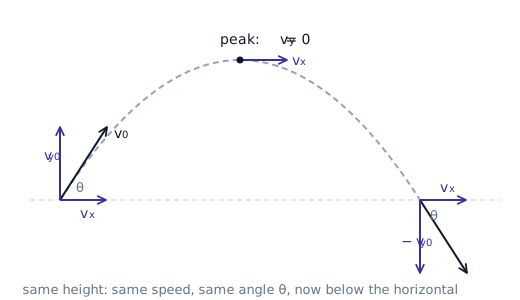
- At the peak of the path, .
- Because of the symmetry of the path, at the same height on the way down the speed is the same as on the way up, and the velocity makes the same angle with the horizontal, now below it: is unchanged and has become .
- We work on the motion in two dimensions, and , separately; the time is what connects them.
The Trajectory Is a Parabola
Exercise. Show that , the trajectory of a projectile, is a parabola.
What does "parabolic" mean? It means that the relation between and is like : is a polynomial of degree in . For example is the parabola shifted one unit to the left and one unit down.
Solution. We may choose the coordinates as we wish; let the projectile start from . Then From the first equation . Putting this into the second, a polynomial of degree in : the trajectory is a parabola, opening downward.
If we write with the speed, , the same result reads .
Example: Thrown off a Cliff
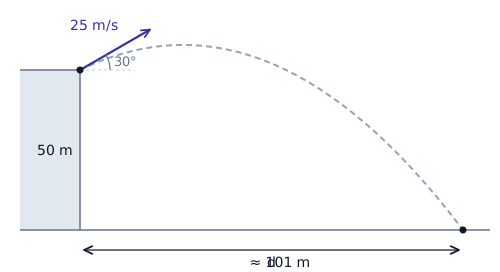
Example. An object is thrown off a cliff m high with the initial velocity m/s at above the horizontal. How far from the base of the cliff does it land? (Take .)
Put the origin at the top of the cliff, where the object is thrown. Then The distance is , where is the total time of the motion. The object lands when : The negative root has no meaning here, so s and
Example: The Monkey and the Dart
Example. A naturalist wants to shoot a monkey with a tranquilizer dart. She aims the dart directly at the monkey. At the moment she shoots, the monkey lets go of the branch and falls freely from rest. Prove that the dart hits the monkey (assuming the dart reaches the monkey's -position before either of them hits the ground).
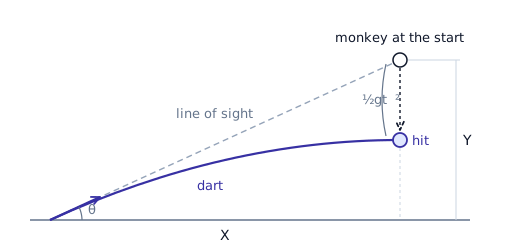
Proof. Put the gun at the origin, let the monkey start at , and let the dart leave with speed at the angle . The dart is aimed at the monkey, so The dart reaches the monkey's -position at the time At that moment the height of the dart is and the monkey, falling from rest, is at the height The two heights are equal, so the dart hits the monkey. Without gravity the dart would fly along the line of sight and the monkey would stay put; gravity moves both of them down by the same .
Flashcards
One card for every definition in these notes. Tap or click a card (or press the space bar) to see the definition; use the arrows to move between cards.
Velocity
The derivative of the position: , the slope of the tangent line to the – graph. Its sign gives the direction of motion.
Average velocity
, the slope of the secant line between two points of the – graph.
Acceleration
The derivative of the velocity: . The average acceleration is .
Speed
The magnitude of the velocity: in one dimension, in two dimensions.
Average speed
. It can differ from the size of the average velocity, because distance counts every part of the path and displacement only the end points.
Displacement
The change of position: on a line, in the plane.
Definite integral
The area between the graph of and the -axis from to (area below the axis counts as negative). It equals for any with .
Scalar and vector
A scalar is a single number without direction (distance, speed, mass, time). A vector has a magnitude and a direction (displacement, velocity, acceleration, force).
Radian
A unit of angle: a full turn is rad, so rad.
Components of a vector
For magnitude and direction : and , how far the vector goes along each axis.
Resultant (tip to tail, parallelogram)
The sum of vectors. Tip to tail: draw from the tip of ; goes from the tail of to the tip of . Parallelogram: draw both from one point; the sum is the diagonal.
Vector subtraction
Adding the opposite vector: , where has the length of and points the opposite way.
Law of sines
In a triangle with sides opposite the angles : .
Law of cosines
, where is the angle between the sides and . For it is the Pythagorean theorem.
Magnitude and direction of a vector
Magnitude ; direction the angle measured counterclockwise from the positive -axis, (add to the calculator's when ).
Unit vectors ,
The vectors of length in the positive and directions; every vector in the plane is .
Position vector and trajectory
, given by two component functions. The curve its tip draws is the trajectory.
Dot product
for , . It equals , so .
Polar coordinates
The distance to the origin and the angle from the positive -axis: , , .